My Adventure Plan
For my multimedia adventure story project, I plan to go paddle boarding on Okanagan Lake and exploring a beach in Kelowna! As you may know from my previous blog posts, I have recently just moved to Kelowna from Victoria, British Columbia. My partner graduated recently and got a full-time job here, and because this is my final term of university and my courses are fully online, I decided to relocate as well and plan to stay after graduating. Since moving here, I have been very interested in exploring and experiencing different activities in the region. Last summer in Victoria, my partner and I got into paddle boarding, and we recently were planning to try it out here in Kelowna while exploring some beaches. I thought this would be a great activity to document for my multimedia story project!
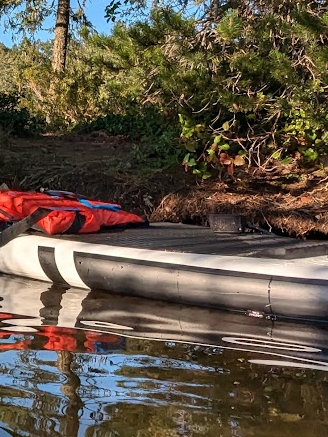
Some things I will need for my adventure are my paddle board and paddle (obviously!), and my phone to take photos, record videos and audio recordings, and document notes. I can keep my phone in a waterproof phone pouch. I would like to document observations around me as we paddle board on the Kelowna Paddle Trail and when we sit at the beach. For example, the sound of the waves, the animals and nature on land, the sandy or rocky shores, and the houses or buildings on land seen from the lake. I might even be able to capture some footage underwater!
Shape of My Multimedia Story
The way in which I will shape my story will be based on the order of events and progress as I go on this little paddle boarding trip. I plan to start off at one beach, where I may document some initial observations and interesting findings. From there, we will paddle along the the Kelowna Paddle Trail, capturing photos with my phone and making other observations and media until we find a nice spot to sit (perhaps another beach). I will make sure to check the location of this spot and note it down (or perhaps I will plan early on where to stop), and I’ll make some more observations and media documentations here. Finally, we’ll head back and I will make my final observations.
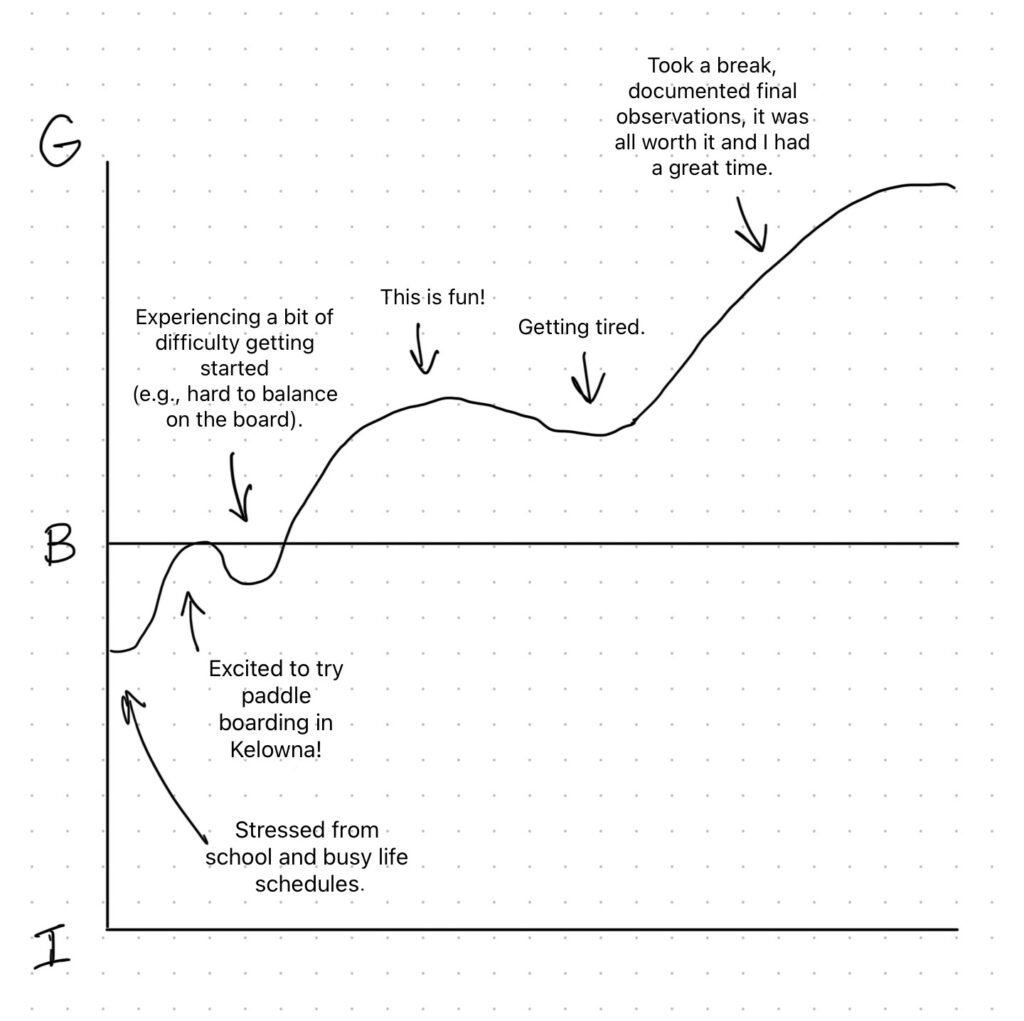
Aside from events, the shape of the story will also follow my moods as go from feeling rather stressed and occupied with day-to-day work to hopefully happier and refreshed after this activity. I have recently been feeling burnout carried over from last semester and stress throughout these past few weeks as I have been cooped up in the house trying to catch up on studies and planning to move into my new apartment. I missed the first week of online courses because I spent the first week packing and moving to Kelowna, so I been trying to catch up on work. I am hoping my story will follow the ups and downs of my moods, similar to what is explained and captured by Kurt Vonnegut’s concept of simple shapes of stories (Comberg, 2010). Below is a graph of what I expect (or at least hope) these ups and downs will look like, based on Kurt Vonnegut’s “Shapes of Stories” graph (Comberg, 2010).
Types of Media and Applied Mayer’s Principles
I plan to use several types of media in my story, including:
- Text:
- Narrating the story/process of my paddle boarding trip,
- Writing my observations on the environment around me, and
- Writing down my feelings and mood observations.
- Image:
- Taking photos of my surroundings (e.g., the beach, the water, nature, animals, what I see on the shore from the water, etc.).
- Possibly sketching anything I found interesting once I get home based on the photos I took (if I have time).
- Video:
- Taking videos of my surroundings (the paddles hitting the water, the waves, sand, trees, animals, etc.).
- Audio:
- Recording sounds of my surroundings (e.g. sounds of the water, birds, wind, etc.)
I would also like to apply Mayer’s 12 Principles of Multimedia Learning in my multimedia story. For example, I will use the redundancy principle to avoid repeating the exact same part of the story twice through different media. An example of redundancy would be adding an image of the paddle board floating on the lake and then writing a text that says “the paddle board floated on the lake” without going into more detail or adding a narration on the meaning that paddle boarding had for me. I will also use the signaling principle by using headings in my text to make it easier to grasp key information about the story. Another principle I will use is the contiguity principle as I will place images, audio, or videos close to related bodies of text so that it is easier for readers/viewers to understand and visualize the story. Finally, another example of a principle I will use is the personalization principle, as I would like to keep my story written in a conversational form so that the story is easier to relate to and more connected with the reader.
References
Comberg, D. (2010, October 30). Kurt Vonnegut on the shapes of stories [Video]. Youtube. https://www.youtube.com/watch?v=oP3c1h8v2ZQ&t=2s
Recent Comments